Bagaimana cara mendapatkan dan berlangganan majalah Poultry Indonesia?
Bagaimana cara membayar pesanan majalah Poultry Indonesia?
Apa itu Advertorial?
Bagaimana cara memasang iklan di website Poultry Indonesia?
Dari mana referensi informasi dalam majalah poultry indonesia?
Dengan siapa saya bisa bertanya seputar kesehatan, penyakit terkait unggas?
Apa itu Poultry Events?
Dengan siapa saya bisa ingin mengajukan kerjasama media partner atau mengadakan suatu kegiatan?
Apa itu Poultry Indonesia?
Poultry Indonesia merupakan majalah yang didirikan pada tahun 1979 di Jakarta, dan menjadi majalah pertama dan tertua di Indonesia yang memiliki ulasan khusus mengenai perunggasan.
Referensi informasi yang tersaji dalam majalah Poultry Indonesia tidak hanya tercakup dalam negeri saja, Poultry Indonesia telah menjalin kerjasama dengan berbagai pihak luar negeri untuk menyajikan informasi terkait perkembangan perunggasan di luar Indonesia.
Poultry Indonesia terdiri dari sekelompok orang yang memiliki dedikasi dan apresiasi tinggi terhadap pekerjaan mereka, dengan senantiasa selalu menyajikan sebuah majalah yang layak dibaca oleh masyarakat perunggasan.
Kapan Majalah Poultry terbit?
Majalah Poultry Indonesia terbit per bulan pada minggu ke-2 dan memiliki dua belas edisi setiap tahun.
Bagaimana cara mendapatkan dan berlangganan majalah Poultry Indonesia?
Majalah Poultry Indonesia tersedia di Toko Buku Gramedia namun dengan kuantiti terbatas. Anda bisa juga langsung membeli dengan menghubungi Poultry Indonesia melalui:
Advertorial adalah artikel yang dimuat di media massa dengan cara membayar yang bertujuan untuk promosi.
Selain itu juga advertorial bisa diartikan sebagai iklan yang disusun atau dibuat sedemikian rupa
sehingga seperti sebuah artikel yang dikarang oleh media cetak yang bersangkutan.
Bagaimana cara memasang iklan di website Poultry Indonesia?
Untuk dapat memasang iklan pada Website Poultry Indonesia dapat menghubungi Divisi Iklan melalui Email:
Darimana referensi informasi dalam majalah poultry indonesia?
Referensi informasi yang tersaji dalam majalah Poultry Indonesia tidak hanya tercakup dalam negeri saja, Poultry Indonesia telah menjalin
kerjasama dengan berbagai pihak luar negeri untuk menyajikan informasi terkait perkembangan perunggasan di luar Indonesia.
Koresponden Luar Negri:
Elis Helinna (New York, Amerika Serikat)
Koresponden Dalam Negeri:
Boy Gunawan Agustino (Tegal),
Muhrishol Yafi (Sidoarjo),
Mahardika Agil Bimasono (Yogyakarta), Sri Maulidini (Purwokerto),
Tri Okto Sareji Adytia (Poso).
Dengan siapa saya bisa bertanya seputar kesehatan, penyakit terkait unggas?
Three Pillars of Preventive Veterinary Medicine on the Farm
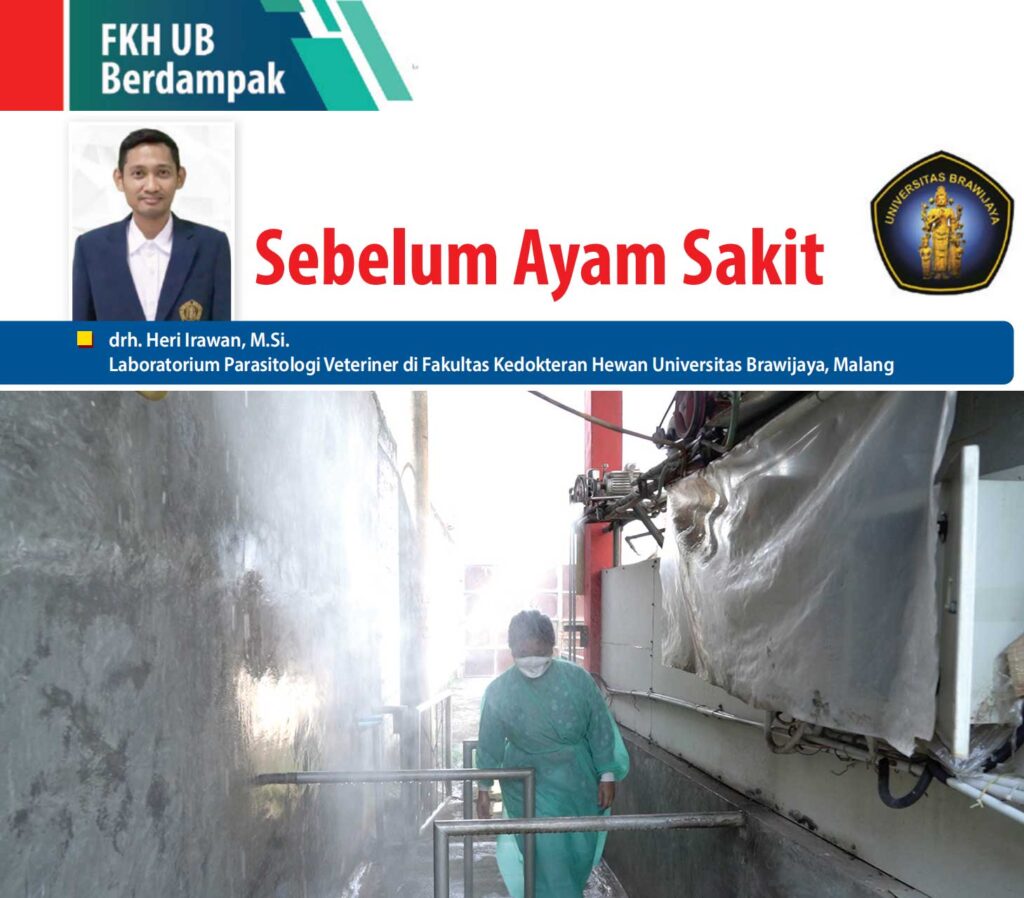
Disease prevention is a key factor in the success of poultry farming, as chicken health determines growth, feed efficiency, and productivity. Raising chickens on commercial farms does not automatically guarantee specific pathogen-free (SPF) status, which means being free from designated pathogens that are regularly monitored. Chickens remain at risk of exposure to pathogenic microorganisms that can enter poultry house environments through farm personnel, equipment, vehicles, wild animals, and airborne aerosols or dust. Such exposure can lead to infections and production losses. Therefore, efforts to maintain chicken health must begin before clinical signs appear through biosecurity, husbandry management, and vaccination. Biosecurity limits the introduction and spread of pathogens; husbandry management ensures adequate feed, drinking water, and oxygen through ventilation to maintain normal body functions and immune defenses; while vaccination builds specific protection against diseases that pose risks on the farm. Consistently implementing all three provides the foundation of preventive veterinary medicine for maintaining poultry health and sustainable production.
Biosecurity Starts at the Farm Entrance
Disease agents can be carried by people, footwear, vehicles, equipment, and pests. Wythe et al. (2026) evaluated microbial contamination on objects and surfaces on poultry farms, as well as the effectiveness of biosecurity measures. Their study is relevant for identifying potential contamination routes in routine farm operations. Practical measures include restricting visitors, recording vehicle movements, using dedicated clothing and footwear, and keeping equipment separate between poultry houses. Organic matter should be removed before disinfection, while disinfectant concentrations and contact times must follow product instructions. Rodents, insects, and wild birds should be controlled, while carcasses and waste must be managed safely. Where possible, an all-in/all-out system should be implemented, whereby one flock enters and leaves together, followed by cleaning and disinfection of the poultry house before the next flock arrives. Biosecurity effectiveness should be assessed daily by monitoring personnel compliance and facility conditions.
Feed Supports Production and Immune Defense
Feed provides the energy and nutrients required for growth, production, and immune defense. Adhikari et al. (2025) explained that amino acids play important roles in tissue development and immune function. Therefore, ration evaluation should consider amino acid balance rather than crude protein percentage alone. Energy, vitamins, and minerals must also be taken into account. Farms should provide feed appropriate to the birds’ age, type, and production stage. Ensure that feed is distributed evenly, feeders are easily accessible, and storage conditions preserve feed quality. Having sufficient feed in storage does not necessarily mean that all chickens receive adequate intake. Monitor feed consumption and assess changes in body weight and flock uniformity. Any decline in feed intake should be investigated by checking feed quality, distribution, drinking water, environmental conditions, and chicken health.
Drinking Water Must Be Safe at the Point of Consumption
Water that appears clear does not necessarily have good microbiological quality. Van Rossum et al. (2026) demonstrated that bacteria from broiler drinking water systems can form biofilms, which are microbial communities that adhere to surfaces. This finding reinforces the importance of maintaining the cleanliness of the inside of water lines. Inspections should cover the water source, storage tanks, pipes, and drinking points. Test water quality regularly and check flow rates at the beginning, middle, and end of each poultry house. Blockages, leaks, and inappropriate water pressure must be corrected promptly. Cleaning and sanitation procedures should be appropriate for the system and products used. Record daily water consumption and prepare a backup supply in case the main source is disrupted or contaminated.
Oxygen Supply Depends on Ventilation
Chickens require oxygen for respiration. Air exchange supplies fresh air while helping remove heat, moisture, and harmful gases. Ventilation performance should therefore be evaluated based on poultry house conditions and bird behavior, rather than simply whether the fans are running. In a study monitoring two broiler farms, Heck et al. (2026) found that ammonia and carbon dioxide exhibited different patterns of change throughout the production cycle. Both gases need to be monitored, as measuring only one is insufficient to assess overall air quality.
Check temperature, humidity, litter conditions, and airflow distribution at multiple points. Panting chickens require an assessment of their thermal environment, as panting does not automatically indicate oxygen deficiency. In closed-house systems, ensuring that alarms, backup generators, and emergency ventilation procedures are ready is also an essential part of prevention.
Vaccination Must Address Disease Challenges
Vaccination programs should be designed according to bird type, age, maternal antibody levels, disease history, and circulating pathogens. Haach et al. (2026) discussed the importance of matching vaccine antigens to field challenges and monitoring protection after vaccination. Veterinarians determine target diseases, vaccine selection, schedules, dosages, and administration routes. Storage, preparation, and administration must follow product instructions. For vaccines administered through drinking water, water quality and solution distribution must be carefully managed to ensure that all birds receive the vaccine uniformly. Vaccination procedures should be documented and evaluated through health monitoring and laboratory testing when necessary. Vaccination must always be supported by good biosecurity and husbandry management.
Prevention Must Be Verified Through Records
Farm managers should record feed and water consumption, mortality, growth or egg production, poultry house conditions, and vaccination activities. Any deviation should be followed up through investigation, corrective action, and evaluation of the results. Preventive veterinary medicine is effective when procedures become routine, measurable activities. Collaboration among veterinarians, farm managers, and poultry house personnel helps ensure that the birds’ needs are met and risk factors are addressed before they cause losses.
Proper and consistent implementation of the three pillars of preventive veterinary medicine—biosecurity, husbandry management, and vaccination—helps keep chickens healthy and productive. These measures provide economic benefits to farmers by reducing disease-related losses, improving production efficiency, and creating opportunities for better farm profitability.
References
Wythe, L.A., et al. (2026). Characterization of microbial contamination and effectiveness of biosecurity measures in poultry operations. Journal of Applied Poultry Research, 35(2): 100691.
Adhikari, R., et al. (2025). Recent advances in protein and amino acid nutritional dynamics in relation to performance, health, welfare, and cost of production. Poultry Science, 104(3): 104852.
Van Rossum, U., et al. (2026). Biofilm formation and multispecies interactions of bacteria recovered from drinking water systems in broiler houses and piglet nursery units. Microbiology Spectrum.
Heck, J., et al. (2026). Levels of two pollutant gases, temperature, and relative humidity and their influence on broiler welfare. Journal of Applied Poultry Research, 35(2): 100694.
Haach, V., Silveira, K.R.D., and Bastos, A.P.A. (2026). Autogenous vaccines: an alternative approach to disease control in poultry. npj Vaccines, 11: 99.