



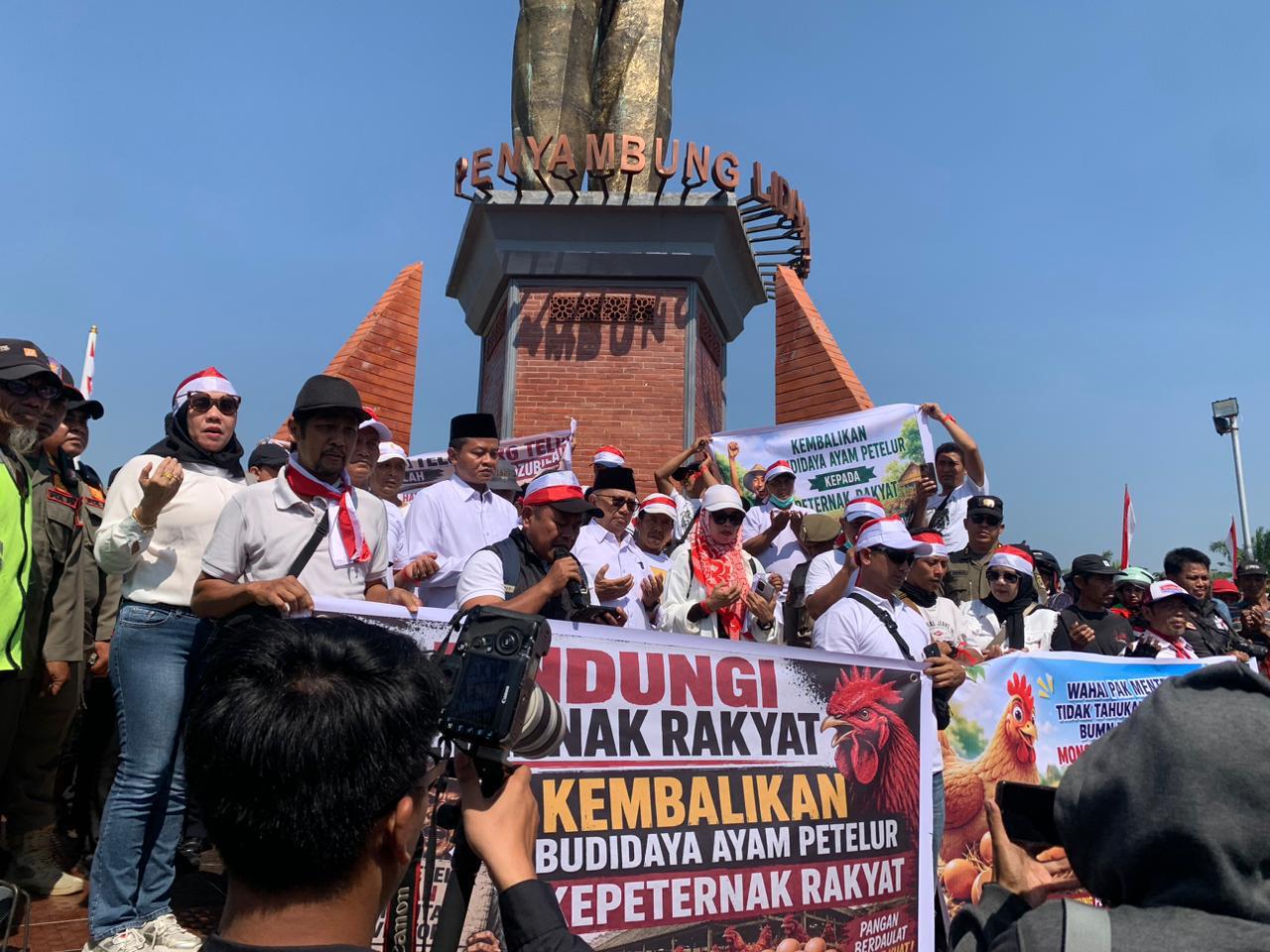
POULTRYINDONESIA, Blitar – Hundreds of small- and medium-scale layer farmers from various regions, including Blitar, Tulungagung, Trenggalek, Kediri, and Malang, held a peaceful demonstration by distributing free eggs to the public at several locations across Blitar Regency, East Java, on Monday (June 1, 2026). The giveaway, claimed to involve 1 million eggs or approximately 62.5 tons, was a form of protest against egg prices falling below the cost of production (COP).
When asked about the root of the problem, Suyanto, the protest coordinator, explained that egg prices have plunged while production costs continue to soar. He noted that the situation has persisted for nearly three months with no signs of improvement.
“Egg prices have been below the government-established cost of production for about two months. At the same time, feed prices have increased. Farm-gate egg prices are currently only around IDR 20,000–21,000 per kilogram, while the cost of production stands at IDR 23,000 per kilogram,” said Suyanto.
With this gap, every kilogram of eggs sold results in a loss for farmers. Suyanto stated that farmers would only feel relieved if prices returned to the range of IDR 24,000–25,000 per kilogram. In addition, livestock feed prices have risen by around 30%, further increasing losses.
Another farmer representative, Suryono, argued that more than 35% of feed ingredients are imported commodities, making them directly affected by the depreciation of the Indonesian rupiah against the U.S. dollar. According to him, the situation is further exacerbated by the monopoly on feed ingredient imports by state-owned enterprise Berdikari, forcing farmers to purchase imported feed materials at higher prices than the market rate.
“The single-gate monopoly on feed ingredient imports has made prices uncompetitive, as they are controlled by Berdikari. Farmers bear an additional burden of around IDR 2,000 per kilogram,” Suryono stated.
Farmers also voiced concerns over plans to allow foreign investors into Indonesia’s livestock sector. They believe that the presence of large investors could intensify competition and potentially marginalize smallholder farmers.
Blitar Regent Rijanto, who met directly with the protesters, urged the central government to take immediate action.
“I heard that the latest farm-gate price is IDR 21,000 per kilogram. This situation requires assistance and support from the central government. We hope the central government will formulate policies in the near future so that small egg farmers in Greater Blitar and surrounding areas can receive immediate relief,” said Rijanto.
He also stated that the Blitar Regency Government would seek to formulate strategic measures to support smallholder farmers. One option being prepared is to expand egg procurement through the Nutritional Fulfillment Service Units (SPPG) under the Free Nutritious Meals Program (MBG), while also encouraging the use of the Red-and-White Cooperative network as a distribution and marketing channel for livestock products.
“If egg procurement is carried out through village cooperatives, price stability can be better maintained and smallholder farmers will be better protected,” Rijanto explained.
Blitar Vice Regent Beky Herdihansah also urged the central government not to remain passive. He pointed out that benchmark selling prices have been established several times, but questioned why the regulations have yet to be effectively implemented in the field.
“Intervention from the central government is urgently needed so that smallholder farmers can survive. Previously, the National Food Agency (Bapanas) proposed a benchmark selling price ranging from IDR 24,500 to IDR 26,500 per kilogram, far above the prices currently received by farmers,” Beky emphasized.