Bagaimana cara mendapatkan dan berlangganan majalah Poultry Indonesia?
Bagaimana cara membayar pesanan majalah Poultry Indonesia?
Apa itu Advertorial?
Bagaimana cara memasang iklan di website Poultry Indonesia?
Dari mana referensi informasi dalam majalah poultry indonesia?
Dengan siapa saya bisa bertanya seputar kesehatan, penyakit terkait unggas?
Apa itu Poultry Events?
Dengan siapa saya bisa ingin mengajukan kerjasama media partner atau mengadakan suatu kegiatan?
Apa itu Poultry Indonesia?
Poultry Indonesia merupakan majalah yang didirikan pada tahun 1979 di Jakarta, dan menjadi majalah pertama dan tertua di Indonesia yang memiliki ulasan khusus mengenai perunggasan.
Referensi informasi yang tersaji dalam majalah Poultry Indonesia tidak hanya tercakup dalam negeri saja, Poultry Indonesia telah menjalin kerjasama dengan berbagai pihak luar negeri untuk menyajikan informasi terkait perkembangan perunggasan di luar Indonesia.
Poultry Indonesia terdiri dari sekelompok orang yang memiliki dedikasi dan apresiasi tinggi terhadap pekerjaan mereka, dengan senantiasa selalu menyajikan sebuah majalah yang layak dibaca oleh masyarakat perunggasan.
Kapan Majalah Poultry terbit?
Majalah Poultry Indonesia terbit per bulan pada minggu ke-2 dan memiliki dua belas edisi setiap tahun.
Bagaimana cara mendapatkan dan berlangganan majalah Poultry Indonesia?
Majalah Poultry Indonesia tersedia di Toko Buku Gramedia namun dengan kuantiti terbatas. Anda bisa juga langsung membeli dengan menghubungi Poultry Indonesia melalui:
Advertorial adalah artikel yang dimuat di media massa dengan cara membayar yang bertujuan untuk promosi.
Selain itu juga advertorial bisa diartikan sebagai iklan yang disusun atau dibuat sedemikian rupa
sehingga seperti sebuah artikel yang dikarang oleh media cetak yang bersangkutan.
Bagaimana cara memasang iklan di website Poultry Indonesia?
Untuk dapat memasang iklan pada Website Poultry Indonesia dapat menghubungi Divisi Iklan melalui Email:
Darimana referensi informasi dalam majalah poultry indonesia?
Referensi informasi yang tersaji dalam majalah Poultry Indonesia tidak hanya tercakup dalam negeri saja, Poultry Indonesia telah menjalin
kerjasama dengan berbagai pihak luar negeri untuk menyajikan informasi terkait perkembangan perunggasan di luar Indonesia.
Koresponden Luar Negri:
Elis Helinna (New York, Amerika Serikat)
Koresponden Dalam Negeri:
Boy Gunawan Agustino (Tegal),
Muhrishol Yafi (Sidoarjo),
Mahardika Agil Bimasono (Yogyakarta), Sri Maulidini (Purwokerto),
Tri Okto Sareji Adytia (Poso).
Dengan siapa saya bisa bertanya seputar kesehatan, penyakit terkait unggas?
The use of antibiotic growth promoters (AGPs) in the poultry industry was initially intended to improve growth, enhance feed efficiency, and reduce mortality. However, continuous use of antibiotics can promote resistance among pathogenic bacteria, including Escherichia coli and Salmonella spp., while also increasing the risk of antibiotic residues in poultry products.
In Indonesia, the use of AGPs as feed additives has been prohibited under Minister of Agriculture Regulation No. 14 of 2017. This policy is important for strengthening food safety and protecting consumer health. Nevertheless, the withdrawal of AGPs presents challenges for farmers, as poultry remain susceptible to infections, inflammation, and gastrointestinal disorders. Therefore, safe, effective, readily available feed additive alternatives that do not leave antibiotic residues are needed.
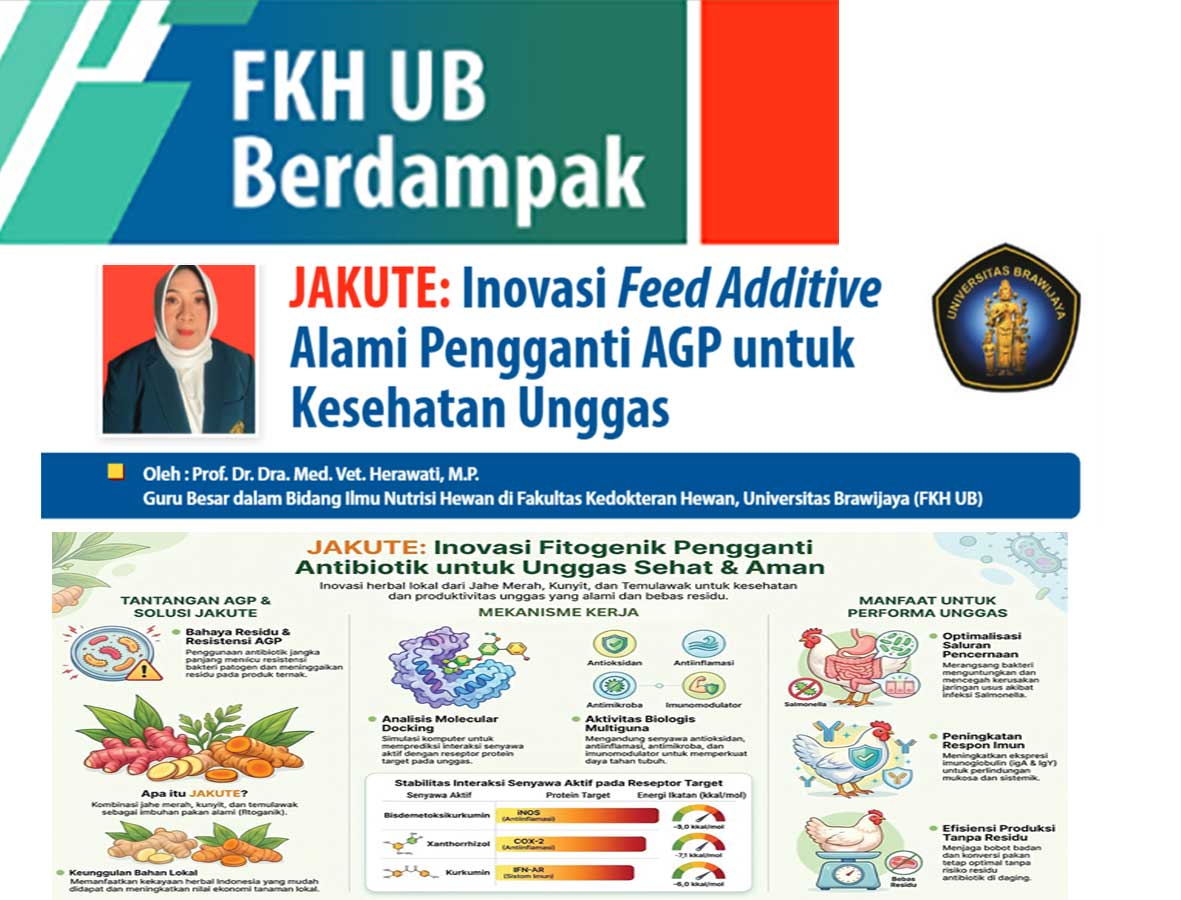
One innovation I have developed is “JAKUTE,” a combination of red ginger, turmeric, and Java turmeric (temulawak) as a phytogenic feed additive. JAKUTE is designed to support poultry health, immunity, and productivity through anti-inflammatory, antioxidant, antimicrobial, and immunomodulatory activities.
The Potential of Three Local Rhizomes
JAKUTE consists of red ginger (Zingiber officinale var. rubrum), turmeric (Curcuma longa), and Java turmeric (Curcuma xanthorrhiza). These three plants are widely available in Indonesia and have long been used as medicinal plants. Red ginger contains the active compounds 6-gingerol and 6-shogaol. Turmeric contains curcumin and tetrahydrocurcumin, while Java turmeric contains demethoxycurcumin, bisdemethoxycurcumin, and xanthorrhizol. These compounds are known to possess biological activities associated with controlling inflammation and regulating immune responses.
The combination of these three rhizomes is expected to provide broader benefits than using a single plant as a feed supplement. Gastrointestinal and immune system conditions have a significant influence on growth, body weight gain, feed efficiency, and poultry productivity. The use of phytogenic ingredients has the potential to improve digestion and nutrient utilization while supporting the quality and safety of livestock products (Upadhaya and Kim, 2017).
TheMolecular DockingApproach
The development of JAKUTE is not based solely on the empirical use of herbal plants. Its active compounds have been studied in silico using the molecular docking method. This computational approach is used to predict interactions between active compounds as ligands and target proteins involved in immune or inflammatory responses. The compounds 6-gingerol, 6-shogaol, curcumin, tetrahydrocurcumin, demethoxycurcumin, and bisdemethoxycurcumin were analyzed as candidate ligands. All have molecular weights below 500 g/mol and log P values below 5. Based on these computational parameters, the active compounds in JAKUTE exhibit initial characteristics that support potential biological interactions.
One of the target proteins studied was the interferon lambda receptor, or IFN-λR, which is associated with regulating immune responses on mucosal surfaces, including the poultry gastrointestinal tract. Curcumin showed the strongest binding affinity to IFN-λR, at -6.0 kcal/mol. This was followed by bisdemethoxycurcumin at -5.3 kcal/mol, tetrahydrocurcumin at -4.8 kcal/mol, 6-gingerol and demethoxycurcumin at -4.5 kcal/mol each, and 6-shogaol at -4.0 kcal/mol. More negative energy values indicate a tendency toward more stable ligand–receptor interactions (Herawati, Al Jabbar, and Oktanella, 2023).
Anti-Inflammatory Potential
Excessive inflammation can damage intestinal tissue and reduce production efficiency. Therefore, JAKUTE compounds were also analyzed against inducible nitric oxide synthase (iNOS), a protein involved in the inflammatory process. Bisdemethoxycurcumin showed a binding energy of -8.0 kcal/mol, lower than sodium diclofenac as the reference ligand, which had a value of -6.7 kcal/mol. Curcumin also demonstrated good affinity, at -6.8 kcal/mol. These findings indicate that bisdemethoxycurcumin and curcumin have the potential to form stable interactions with iNOS. Differences in their binding conformations compared with sodium diclofenac suggest the possibility of a noncompetitive inhibitory mechanism (Herawati, Oktanella, and Anisa, 2021). In chicken COX-2 protein, xanthorrhizol from Java turmeric showed a binding energy of -7.1 kcal/mol. This result indicates that Java turmeric makes an important contribution to JAKUTE’s anti-inflammatory potential (Herawati et al., 2021). However, molecular docking remains a computational prediction, and the findings need to be confirmed through in vitro, in vivo, and field studies.
Supporting Immunity and Gut Health
The potential of JAKUTE is further supported by research on the use of red ginger in broiler chickens. Adding red ginger powder to starter-phase feed was reported to stimulate the growth of beneficial bacteria in the gastrointestinal tract compared with the administration of tetracycline as an AGP (Herawati et al., 2020). Other research has shown that red ginger powder has the potential to enhance both specific and nonspecific immune responses. Its administration increased the expression of immunoglobulin A and immunoglobulin Y and helped prevent intestinal damage caused by Salmonella Enteritidis infection (Herawati et al., 2022). A healthy intestine enables digestion and nutrient absorption to occur optimally. Conversely, prolonged inflammation can divert energy and nutrients that should otherwise be used for growth toward the body’s defense response. JAKUTE is therefore being developed not only as a natural antimicrobial, but also as an immunomodulator and anti-inflammatory agent.
Toward On-Farm Application
JAKUTE offers the advantages of locally available raw materials and the potential to produce poultry products without antibiotic residues. However, its application requires standardization because the concentration of active compounds can be affected by variety, cultivation location, harvest age, drying, storage, and processing methods. The appropriate dosage must also be determined to achieve the desired biological benefits without reducing palatability or feed intake. Further research is needed to evaluate body weight gain, feed conversion ratio, mortality, immune response, gut microbiota, carcass quality, and economic efficiency.
With standardized formulations and continued testing, JAKUTE has the potential to become an AGP alternative based on Indonesia’s rich herbal resources, supporting healthier, safer, and more sustainable poultry production.