

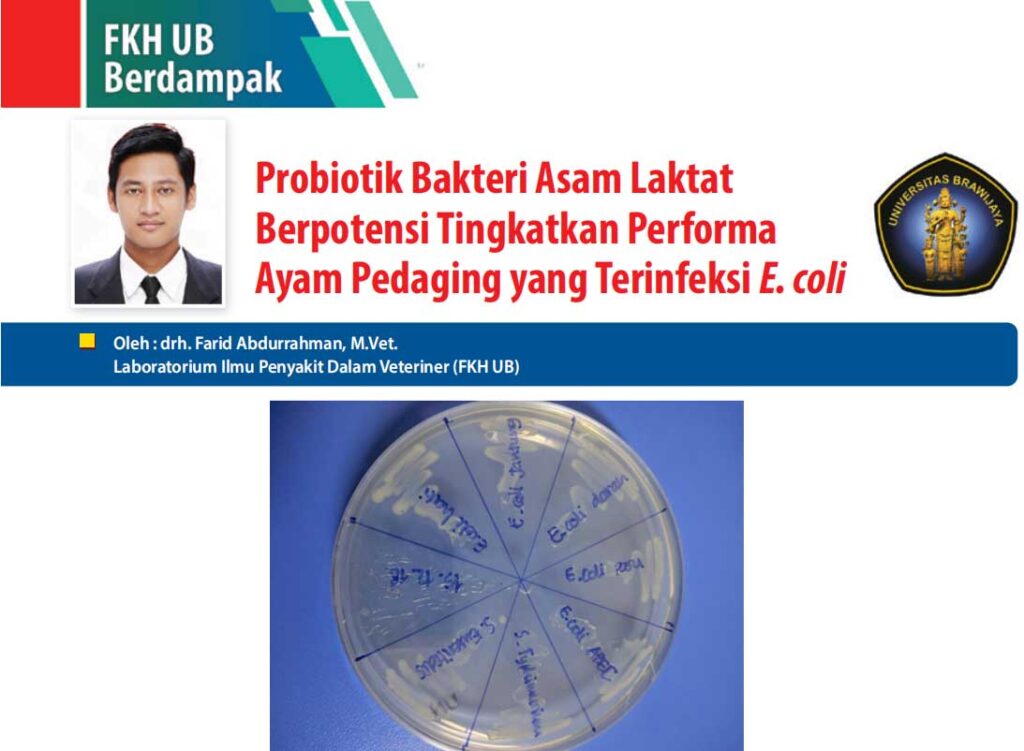
When bacterial infection affects broiler performance, the administration of lactic acid bacteria probiotics shows potential to help maintain performance while also offering prospects for application at the farm scale.
Broilers are expected to achieve optimal growth within a relatively short period. However, when an Escherichia coli infection occurs, bird performance can be affected. This condition has prompted research into the use of lactic acid bacteria (LAB) probiotics as a treatment for broilers infected with E. coli.
When E. coli Becomes a Challenge for Farmers
Poultry farming is considered one of the efficient sectors for providing essential nutrients through animal-based sources. Chicken meat itself is one of the animal protein sources widely consumed by the public (Directorate General of Livestock, 2016).
However, increasing poultry production and consumption also brings various challenges in poultry management. One of these is colibacillosis, a disease associated with Escherichia coli infection.
In poultry, colibacillosis is generally associated with avian pathogenic E. coli (APEC). This bacterium can cause disease in poultry and create challenges in chicken production (Mellata et al., 2003).
Transmission of E. coli can occur through the oral route, including via feed, drinking water, and feces contaminated with the bacteria. When infection occurs, the problem is not limited to chicken health but can also result in economic challenges for farmers.
Chickens that are unable to maintain optimal performance can affect production outcomes. In broiler production, changes in performance are particularly important because they are closely related to feed-use efficiency, body weight gain, rearing duration, and final production results.
Seeking an Alternative: Not Merely Addressing the Problem, but Maintaining Performance
One approach that can be used to support livestock health is probiotics.
According to FAO/WHO (2002), probiotics are live microorganisms that, when administered in adequate amounts, confer a health benefit on the host.
In this study, the probiotic used was Lactoped®, which contains several groups of bacteria, namely Lactobacillus casei, Lactobacillus plantarum, Lactobacillus fermentatum, Lactobacillus acidophilus, Pediococcus, and Bifidobacterium.
Lactic acid bacteria such as Lactobacillus are known to produce various metabolites, including lactic acid, hydrogen peroxide, and bacteriocins. These compounds have the potential to inhibit the growth of pathogenic bacteria (Farida et al., 2015).
Therefore, probiotics represent an interesting approach to investigate in broiler production, particularly when birds face the challenge of E. coli infection.
From 30 Chickens, Researchers Compared Three Treatments
To determine the effects of probiotic administration, the researchers conducted an experiment involving 30 broiler chickens.
In simple terms, the study can be viewed as a comparison of several groups of chickens receiving different treatments. The chickens were randomly divided into three treatment groups: P0, P1, and P2. Each group was then given treatment according to the research design.
The method used was a true experimental study with a post-test-only control group design. This means the researchers administered specific treatments to predetermined groups and then compared the outcomes after the treatments had been administered.
The study employed a Completely Randomized Design (CRD). The chickens were randomly assigned to the groups so that each chicken had an equal opportunity to be placed in any of the available treatment groups.
This approach allowed the researchers to determine whether differences in performance occurred after the chickens received different treatments.
What Happened After the Probiotics Were Administered?
The results showed that broilers infected with E. coli and given LAB probiotics at a concentration of 10⁸ CFU/ml had a higher performance index.
This finding is particularly interesting because the study did not examine the chickens solely from a biological perspective, but also attempted to address an important question in poultry production:
Does the use of these probiotics also make sense from a business perspective?
This question is important because a livestock innovation must do more than demonstrate positive results in animals. Farmers also need to consider whether its application is economically feasible.
It Is Not Just About the Chickens, but Also About the Economics
The study was subsequently followed by a business analysis.
At the small research scale, involving 10 chickens per treatment, the use of probiotics did not demonstrate economic feasibility because it resulted in a loss.
However, when the calculation was applied to a farm-scale operation involving approximately 2,000 chickens per production cycle, the results were different.
Administration of LAB probiotics at a concentration of 10⁸ CFU/ml at this scale generated a Contribution Margin sufficient to cover all fixed costs. Based on the study’s analysis, this made the business still reasonable to operate.
The difference between the results at the research scale and the farm scale is one of the important points of the study.
Why Does Scale Matter?
Imagine a researcher using only a few chickens for an experiment. The costs incurred must be allocated across a very small number of birds. This is naturally different when the same technology is applied to thousands of chickens within a single production cycle.
Therefore, economic results at the research scale do not necessarily reflect the results when the technology is implemented at the farm scale.
In this study, a farm scale of approximately 2,000 chickens showed that the Contribution Margin could cover fixed costs. In contrast, the research scale of 10 chickens per treatment still resulted in a loss.
These findings indicate that evaluating a poultry innovation requires consideration of more than one aspect: animal performance and economic feasibility.
From the Laboratory to the Farm
This study provides an indication that the use of LAB probiotics at 10⁸ CFU/ml in broilers infected with E. coli shows potential to improve the performance index.
Interestingly, the study also demonstrated that implementation at a larger scale can produce a different economic picture compared with small-scale experimental trials.
Thus, the use of probiotics is not merely a matter of what happens to the chickens, but also how realistically the technology can be implemented by farmers.
These findings open up opportunities to view poultry innovations more comprehensively: do they benefit the animals, and are they economically feasible for farmers to implement?
References
Abdurrahman, F., Soeharsono, S., & Soepranianondo, K. (2022). Study of Performance Index and Business Analysis on Chicken Infected by Escherichia coli with Probiotic Provision of Lactic Acid Bacteria. Jurnal Medik Veteriner, 5(1), 74–80. https://doi.org/10.20473/jmv.vol5.iss1.2022.74-80
Directorate General of Livestock and Animal Health. (2016). Broiler Chicken Production by Province.
FAO/WHO. (2002). Guidelines for the Evaluation of Probiotics in Food: Report of a Joint FAO/WHO Working Group on Drafting Guidelines for the Evaluation of Probiotics in Food. Canada.
Farida, K. A., Busono, W., & Sjofjan, O. (2015). Pengaruh Penambahan Probiotik Cair Dalam Pakan Terhadap Penampilan Produksi Pada Ayam Pedaging. Master’s Program in Animal Science, Faculty of Animal Husbandry, Brawijaya University, Malang. p. 12.
Mellata, M., Dho-Moulin, M., Dozois, C. M., Curtiss, I. R., Brown, P. K., Arné, P., Brée, A., Desautels, C., & Fairbrother, J. M. (2003). Role of virulence factors in resistance of avian pathogenic Escherichia coli to serum and in pathogenicity. Infection and Immunity, 71, 536–540.