Bagaimana cara mendapatkan dan berlangganan majalah Poultry Indonesia?
Bagaimana cara membayar pesanan majalah Poultry Indonesia?
Apa itu Advertorial?
Bagaimana cara memasang iklan di website Poultry Indonesia?
Dari mana referensi informasi dalam majalah poultry indonesia?
Dengan siapa saya bisa bertanya seputar kesehatan, penyakit terkait unggas?
Apa itu Poultry Events?
Dengan siapa saya bisa ingin mengajukan kerjasama media partner atau mengadakan suatu kegiatan?
Apa itu Poultry Indonesia?
Poultry Indonesia merupakan majalah yang didirikan pada tahun 1979 di Jakarta, dan menjadi majalah pertama dan tertua di Indonesia yang memiliki ulasan khusus mengenai perunggasan.
Referensi informasi yang tersaji dalam majalah Poultry Indonesia tidak hanya tercakup dalam negeri saja, Poultry Indonesia telah menjalin kerjasama dengan berbagai pihak luar negeri untuk menyajikan informasi terkait perkembangan perunggasan di luar Indonesia.
Poultry Indonesia terdiri dari sekelompok orang yang memiliki dedikasi dan apresiasi tinggi terhadap pekerjaan mereka, dengan senantiasa selalu menyajikan sebuah majalah yang layak dibaca oleh masyarakat perunggasan.
Kapan Majalah Poultry terbit?
Majalah Poultry Indonesia terbit per bulan pada minggu ke-2 dan memiliki dua belas edisi setiap tahun.
Bagaimana cara mendapatkan dan berlangganan majalah Poultry Indonesia?
Majalah Poultry Indonesia tersedia di Toko Buku Gramedia namun dengan kuantiti terbatas. Anda bisa juga langsung membeli dengan menghubungi Poultry Indonesia melalui:
Advertorial adalah artikel yang dimuat di media massa dengan cara membayar yang bertujuan untuk promosi.
Selain itu juga advertorial bisa diartikan sebagai iklan yang disusun atau dibuat sedemikian rupa
sehingga seperti sebuah artikel yang dikarang oleh media cetak yang bersangkutan.
Bagaimana cara memasang iklan di website Poultry Indonesia?
Untuk dapat memasang iklan pada Website Poultry Indonesia dapat menghubungi Divisi Iklan melalui Email:
Darimana referensi informasi dalam majalah poultry indonesia?
Referensi informasi yang tersaji dalam majalah Poultry Indonesia tidak hanya tercakup dalam negeri saja, Poultry Indonesia telah menjalin
kerjasama dengan berbagai pihak luar negeri untuk menyajikan informasi terkait perkembangan perunggasan di luar Indonesia.
Koresponden Luar Negri:
Elis Helinna (New York, Amerika Serikat)
Koresponden Dalam Negeri:
Boy Gunawan Agustino (Tegal),
Muhrishol Yafi (Sidoarjo),
Mahardika Agil Bimasono (Yogyakarta), Sri Maulidini (Purwokerto),
Tri Okto Sareji Adytia (Poso).
Dengan siapa saya bisa bertanya seputar kesehatan, penyakit terkait unggas?
Good poultry health is the key to supporting optimal performance across all aspects of production. Protecting animal welfare, reducing the impact of disease outbreaks, and maintaining food safety through the implementation of biosecurity are essential in every farm operation.
A strong biosecurity program begins by ensuring that the poultry house is clean before the arrival of the DOCs. Before the house downtime period begins, develop a detailed cleaning plan. While the house is still warm, apply an appropriate insecticide spray. Ensure that personal protective equipment (PPE) is worn throughout the process. Next, remove all dust and cobwebs from equipment and the interior of the poultry house. Spray the interior of the house with disinfectant to wet down the dust. Close all house curtains, remove all movable equipment, and take out all permanently installed equipment. Remove and dispose of all litter. Litter should be transported at least 2 miles (3.2 km) away from the farm premises. Wash the emptied house with detergent, then rinse with hot water.
Drain, clean, and rinse the drinking water system. Use a strong chlorine solution at 140 ppm for 24 hours to remove biofilm. Next, fill the water system with a mild acid solution, such as acetic acid, for 24 hours to remove scale, then rinse the system. Empty, wash, and disinfect all feeding equipment. Clean the interior of all feed silos or bins using a brush and seal all gaps or openings. If possible, fumigate the feeding system.
For chemicals to work effectively, all surfaces must be free of dirt and organic matter. Once the poultry house is completely dry, apply an approved disinfectant. Applying disinfectant to wet surfaces can cause dilution and reduce its effectiveness.
Most disinfectants are not effective against coccidial oocysts. If formalin fumigation is permitted, it should be carried out immediately after disinfection, while the house surfaces are still damp. Seal the house tightly and prevent anyone from entering for at least 24 hours. Ventilate the house before allowing entry.
Fumigation should be repeated after fresh litter has been placed. Reapply insecticide before the next flock is placed.
A biosecurity program should be:
Strong and comprehensive
Mandatory
Practical
Cost-effective
Integrated into employee training
Supported by an adequate budget
Reviewed regularly
Areas outside the poultry house should also be washed and disinfected. Pay particular attention to areas where dust accumulates or traffic is high, such as beneath fans, under feed bins, traffic routes, doors, and gutters. The poultry house should ideally be surrounded by a concrete or gravel apron. At a minimum, remove all vegetation around the house. Ensure that these areas are free of equipment and machinery.
Before birds are placed, the poultry house should be tested for Salmonella and total bacterial counts. If the test results exceed the established thresholds or Salmonella is detected, the house must be cleaned again and, if necessary, fumigated.
Best practice is to implement a negative release program, meaning that a new flock may only be placed once test results meet the established criteria. Regular monitoring of microorganism levels over time can help improve poultry house hygiene standards.
Water quality should also be monitored at least once a year. The target is zero coliform colonies in the drinking water system. If chlorine is used to disinfect the water system, the target free chlorine level at the end of the line is 3–5 ppm. There are various other water treatment methods that can be used as needed. Regular flushing of the water system is also recommended to prevent biofilm buildup. If organic matter is found in the water after flushing, the water sanitation program should be evaluated and adjusted.
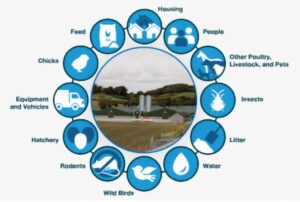
People, clothing, and equipment brought into the farm (fomites) are major sources of pathogen transmission. The farm premises should be fenced to prevent unauthorized access. Everyone entering the farm must record their visit in a visitor log. Ideally, everyone entering the farm should shower first. At a minimum, everyone must change into clean clothing and footwear. Limit the equipment brought onto the farm, including mobile phones and lunch boxes. All equipment must be cleaned and disinfected before being allowed into the farm area. Use dedicated footwear for each poultry house or, at a minimum, disinfect footwear before moving from one house to another. Hands must be washed or disinfected before entering poultry areas. Visits to flocks or poultry houses should be conducted in sequence, starting with the youngest flock and progressing to the oldest.
Wild birds, insects, and other animals can carry a variety of diseases. Therefore, efforts should be made to ensure that the farm environment does not attract these animals. Immediately clean up any spilled feed and store all feed and litter indoors. Do not leave machinery or equipment outside the poultry house. Remove all garbage and waste materials. Ensure that bird-proof netting and insect screens are always in good condition. Prevent wild birds from roosting or nesting on farm buildings. Ensure that the rodent control program is effective. Cover all open water sources to prevent birds, reptiles, and amphibians from approaching them.
Where possible, implement an “all-in/all-out” system on the farm. A downtime period between flocks can reduce the risk of disease transmission. Aim for a minimum of 7 days of downtime between flocks. However, farms that have previously experienced health problems should implement a longer downtime period, accompanied by more specific additional hygiene measures.
Biosecurity is not the only defense we have against disease, but it is the first line of defense. Thorough cleaning and disinfection of the poultry house, followed by the implementation of proper basic procedures throughout the flock rearing period, will help protect poultry health while maintaining production performance.
For more information, visit the Info Centre at www.aviagen.com or scan the QR code.