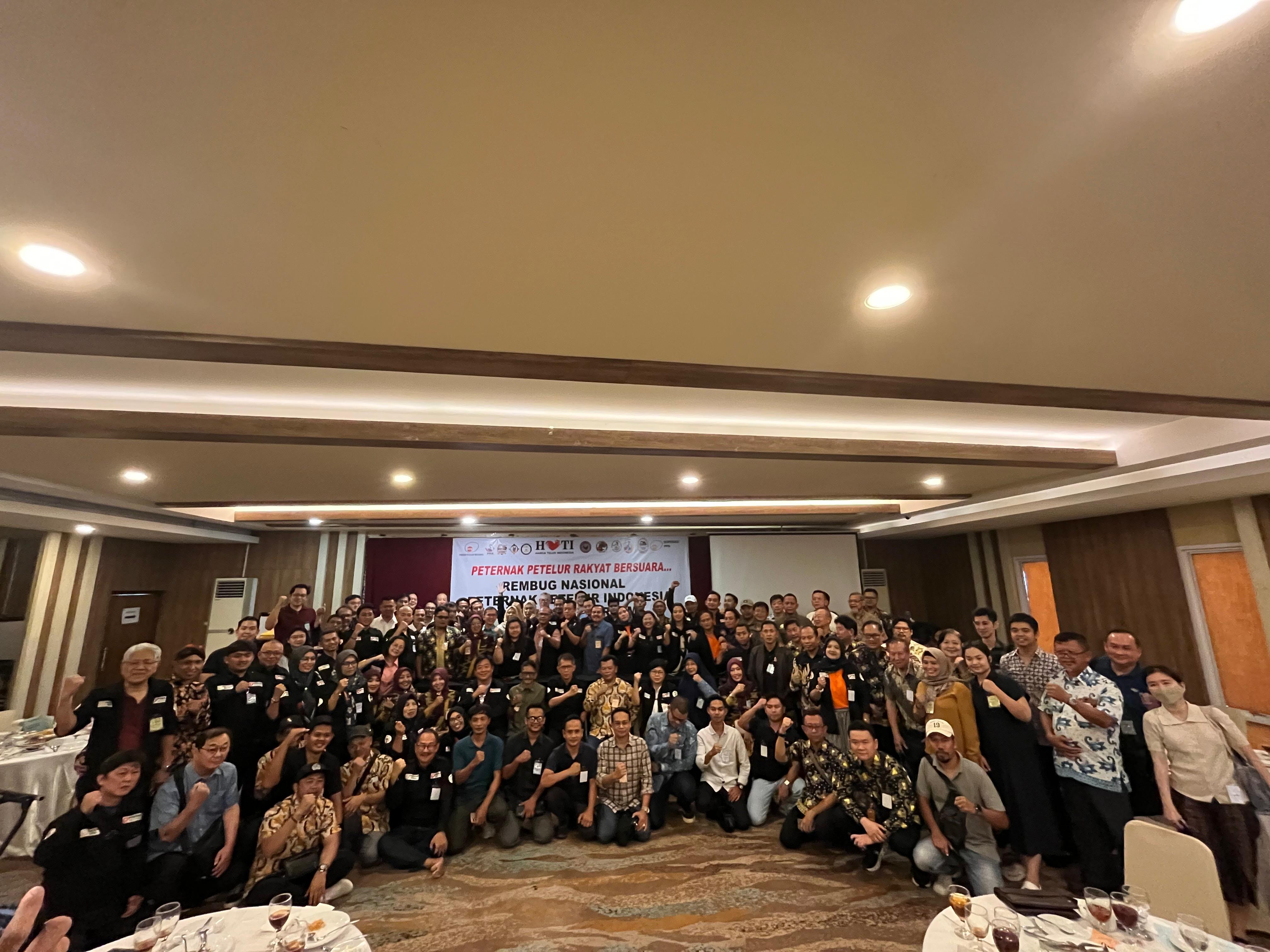
POULTRYINDONESIA, Jakarta – Layer farmers, through the National Layer Farmers Association (Pinsar Petelur Nasional/PPN), have brought a number of increasingly pressing issues affecting the sustainability of their businesses to Commission IV of the Indonesian House of Representatives (DPR RI). High feed costs amid low egg prices have made it difficult for farmers to keep their businesses running. Some farmers have even begun emptying their poultry houses because they can no longer afford to purchase feed.
The issues were raised by Chairman of Pinsar Central Java, Suwardi, during a Public Hearing Meeting (RDPU) with Commission IV of the DPR RI on Wednesday (October 7, 2026). According to him, pressure on farmers has persisted since April 2026, when production costs continued to rise while egg prices at the farm level remained well below the government reference price.
“For us, since April 2026 until today, production costs and production returns have been completely out of balance,” Suwardi said during the meeting.
One of the biggest issues highlighted was the high price and limited availability of corn. As the main raw material for layer feed, accounting for around 50% of the formulation, changes in corn prices have a direct impact on production costs.
Suwardi said the current price of KA 15 dry shelled corn has reached around Rp7,500–Rp8,000 per kg. Meanwhile, soybean meal, another key feed ingredient, also remains expensive, pushing the market price of concentrate to Rp9,000–Rp9,500 per kg. The price of rice bran has also increased. Previously priced at around Rp3,500–Rp4,000 per kg, it is now reportedly around Rp6,000 per kg. With a feed formulation consisting of 50% corn, 15% rice bran, and 35% concentrate, farmers calculate that current feed costs have reached approximately Rp8,155 per kg.
“If we calculate this formulation today, with the average price of corn received by farmers at nearly Rp8,000, the feed cost comes to Rp8,155 per kg,” he explained.
According to Suwardi, the corn problem is not only about high prices but also availability. Farmers are reportedly struggling to obtain corn even when they have the money to buy it.
“Why? Because with corn prices already high, the availability of corn is extremely limited. What are we supposed to do? Corn accounts for 50% of the formulation and, for us smallholder farmers, it cannot yet be replaced by anything else,” he said.
Amid rising production costs, egg prices at the farm level remain far below the government reference price. Suwardi said that under National Food Agency Regulation (Perbadan) No. 6 of 2024, the reference purchase price for eggs at the farm level is Rp26,500 per kg. However, since April 2026, farmers have received an average of only Rp19,000–Rp20,000 per kg.
Egg prices even fell to a low of Rp17,100 per kg in June 2026. Averaged over the past six months, the price received by farmers has been only around Rp20,000–Rp21,000 per kg.
Under these conditions, farmers are estimated to be suffering losses of around Rp5,000–Rp7,000 per kg per day. Months of sustained pressure have begun to affect farmers’ ability to maintain their layer populations.
“We came here with heavy hearts. Why? We are raising living creatures, and if we cannot provide them with feed, we would feel even more guilty,” Suwardi said.
He said some farmers have even emptied their poultry houses because they can no longer afford feed. “Today, farmers—as we say in Java—would joke that chickens could eat sengon trees, mahogany trees, or, for those who have cattle, even feed them cattle. But today, some of our fellow farmers already have completely empty poultry houses because they can no longer afford to feed their chickens,” he said.
To ensure the sustainability of smallholder farmers’ businesses, Suwardi urged the government to guarantee corn supplies at reasonable prices. According to him, farmers estimate that they will need around 223,000 tons of corn for the period from October 2026 to February 2027. This requirement is considered increasingly important amid concerns over a prolonged dry season and the threat of El Niño over the next five months.
“Over the next five months, with a prolonged dry season and the possibility of El Niño, we estimate that we will need 223,000 tons of corn to be used through February. If there is no corn, what are we supposed to do?” Suwardi said.
He added that farmers cannot always easily obtain corn even when they have the purchasing power. “Sometimes, even when we have a little money to buy corn, we have to compete with each other for it,” he said.
In addition to requesting certainty of corn supplies at reasonable prices, farmers are also calling on the government to strengthen the absorption of locally produced eggs through various government programs, including food assistance.
According to Suwardi, weak demand has caused egg production to accumulate, with some output going unsold. Government programs could serve as one channel to help absorb farmers’ production. “Hopefully, one of the options is for the National Food Agency (Bapanas) to use eggs for government food assistance,” he said.
Farmers are also calling on the government to evaluate the import and distribution system for feed ingredients, particularly soybean meal and its derivatives. The evaluation is expected to create room to reduce feed ingredient costs and improve the production cost structure at the farm level.
In addition to feed and market issues, farmers also raised concerns about the direction of government programs through Danantara. They called for the development of integrated livestock farming not to take over layer farming activities that have traditionally been carried out by smallholder farmers.
Instead, the program is expected to focus on strengthening downstream industries, particularly in regions experiencing egg surpluses such as East Java, Central Java, and Lampung. “Return farming activities to the people. We are already capable of raising chickens, and we are already capable of achieving self-sufficiency. The only issue is that distribution is not yet even,” Suwardi said.
Farmers have proposed the development of downstream industries such as egg powder and chicken meat powder factories. Such industries are considered capable of absorbing egg and chicken meat production during periods of oversupply while reducing dependence on imported products.
Before Commission IV of the DPR RI, Suwardi expressed hope that the problems faced by farmers would not stop at discussion but would be followed by concrete action. Certainty of corn supplies, reasonable feed ingredient prices, and egg absorption are among the urgent needs identified by farmers.
“If there is no solution, we will go home unable to feed our chickens. We have no money in Jakarta. Are we, the farmers, supposed to become beggars in Jakarta?” he said.
He reiterated that smallholder farmers need certainty so they can continue running their businesses and supporting their families.
“Our hope, once again, is that corn can be provided to us at a balanced price, so that we can continue our businesses as poultry farmers and support our families,” Suwardi concluded.
For more information about Indonesia’s poultry industry, join the Satwa Media Group WhatsApp Channel.