Bagaimana cara mendapatkan dan berlangganan majalah Poultry Indonesia?
Bagaimana cara membayar pesanan majalah Poultry Indonesia?
Apa itu Advertorial?
Bagaimana cara memasang iklan di website Poultry Indonesia?
Dari mana referensi informasi dalam majalah poultry indonesia?
Dengan siapa saya bisa bertanya seputar kesehatan, penyakit terkait unggas?
Apa itu Poultry Events?
Dengan siapa saya bisa ingin mengajukan kerjasama media partner atau mengadakan suatu kegiatan?
Apa itu Poultry Indonesia?
Poultry Indonesia merupakan majalah yang didirikan pada tahun 1979 di Jakarta, dan menjadi majalah pertama dan tertua di Indonesia yang memiliki ulasan khusus mengenai perunggasan.
Referensi informasi yang tersaji dalam majalah Poultry Indonesia tidak hanya tercakup dalam negeri saja, Poultry Indonesia telah menjalin kerjasama dengan berbagai pihak luar negeri untuk menyajikan informasi terkait perkembangan perunggasan di luar Indonesia.
Poultry Indonesia terdiri dari sekelompok orang yang memiliki dedikasi dan apresiasi tinggi terhadap pekerjaan mereka, dengan senantiasa selalu menyajikan sebuah majalah yang layak dibaca oleh masyarakat perunggasan.
Kapan Majalah Poultry terbit?
Majalah Poultry Indonesia terbit per bulan pada minggu ke-2 dan memiliki dua belas edisi setiap tahun.
Bagaimana cara mendapatkan dan berlangganan majalah Poultry Indonesia?
Majalah Poultry Indonesia tersedia di Toko Buku Gramedia namun dengan kuantiti terbatas. Anda bisa juga langsung membeli dengan menghubungi Poultry Indonesia melalui:
Advertorial adalah artikel yang dimuat di media massa dengan cara membayar yang bertujuan untuk promosi.
Selain itu juga advertorial bisa diartikan sebagai iklan yang disusun atau dibuat sedemikian rupa
sehingga seperti sebuah artikel yang dikarang oleh media cetak yang bersangkutan.
Bagaimana cara memasang iklan di website Poultry Indonesia?
Untuk dapat memasang iklan pada Website Poultry Indonesia dapat menghubungi Divisi Iklan melalui Email:
Darimana referensi informasi dalam majalah poultry indonesia?
Referensi informasi yang tersaji dalam majalah Poultry Indonesia tidak hanya tercakup dalam negeri saja, Poultry Indonesia telah menjalin
kerjasama dengan berbagai pihak luar negeri untuk menyajikan informasi terkait perkembangan perunggasan di luar Indonesia.
Koresponden Luar Negri:
Elis Helinna (New York, Amerika Serikat)
Koresponden Dalam Negeri:
Boy Gunawan Agustino (Tegal),
Muhrishol Yafi (Sidoarjo),
Mahardika Agil Bimasono (Yogyakarta), Sri Maulidini (Purwokerto),
Tri Okto Sareji Adytia (Poso).
Dengan siapa saya bisa bertanya seputar kesehatan, penyakit terkait unggas?
Amidst the various challenges of modern poultry health, such as avian influenza, Newcastle disease, and colibacillosis, there is one disease that is relatively rarely discussed yet carries severe implications for both poultry health and public health: avian tuberculosis (also known as avian mycobacteriosis). This disease is chronic, slow-developing, and frequently goes undetected until it reaches an advanced stage, thereby posing a potential threat of significant economic loss to livestock operations.
When chicken performance drops, egg production declines, or several birds appear increasingly emaciated without any obvious cause, farmers typically focus their attention on common diseases like colibacillosis or Newcastle disease. However, there is a chronic disease that often evades notice due to its extremely slow progression, namely avian tuberculosis / avian mycobacteriosis.
This disease is primarily caused by Mycobacterium avium subsp. avium, a bacterium capable of infecting almost all bird species, ranging from chickens, turkeys, and waterfowl to pigeons, ornamental birds, and wildlife. One of the reasons why mycobacteriosis is incredibly difficult to control is the causative bacteria’s ability to persist in the environment for extended periods.
Transmission generally occurs through the ingestion of feed or water contaminated with the feces of infected birds. Wild birds and carrier poultry also play a vital role as disease reservoirs. Furthermore, farm equipment, workers’ footwear, contaminated litter, and multi-age management systems can substantially elevate the risk of infection spread.
Clinical Signs and Pathology
Unlike acute diseases that develop rapidly, avian tuberculosis / avian mycobacteriosis is chronic and progressive. Clinical signs are often non-specific, making them easy to overlook. Infected poultry typically manifest gradual weight loss, severe emaciation (going light), weakness, chronic diarrhea, anemia, and reduced egg production. In some cases, respiratory distress and swelling around the eyes may be observed.
In advanced stages, the infection can lead to organ failure and ultimately end in death. The characteristic lesions of this disease can be identified during necropsy. Organs such as the intestines, liver, and spleen frequently exhibit yellowish-white nodules or granulomas resembling tubercles. The liver and spleen are commonly enlarged (hepatomegaly and splenomegaly) due to the formation of granulomatous tissue. In certain cases, lesions can also be found in the bone marrow, lungs, skin, or eyes.
Avian tuberculosis / Avian mycobacteriosis represents a threat that must not be disregarded. Its chronic nature, subtle detection profile, and long-term environmental persistence pose hidden challenges to both traditional and modern poultry industries. Vigilance and early detection remain the ultimate keys to safeguarding flock health and ensuring the sustainability of livestock businesses.
REFERENCES
Abd El-Ghany, W. A. (2022). A review of avian mycobacteriosis: An emerging bacterial disease of public health concern. International Journal of One Health, 8(2), 70–75. https://doi.org/10.14202/IJOH.2022.70-75
Sattar, A., Zakaria, Z., Abu, J., Aziz, S. A., & Rojas-Ponce, G. (2021). Isolation of Mycobacterium avium and other nontuberculous mycobacteria in chickens and captive birds in peninsular Malaysia. BMC Veterinary Research, 17, Article 13. https://doi.org/10.1186/s12917-020-02695-8
Tsiouris, V., Kiskinis, K., Mantzios, T., Dovas, C. I., Mavromati, N., Filiousis, G., Brellou, G., Vlemmas, I., & Georgopoulou, I. (2021). Avian mycobacteriosis and molecular identification of Mycobacterium avium subsp. avium in racing pigeons (Columba livia domestica) in Greece. Animals, 11(2), 291. https://doi.org/10.3390/ani11020291
World Organisation for Animal Health. (2024). Avian tuberculosis. In WOAH terrestrial manual 2024 (Chapter 3.3.6). World Organisation for Animal Health. https://www.woah.org







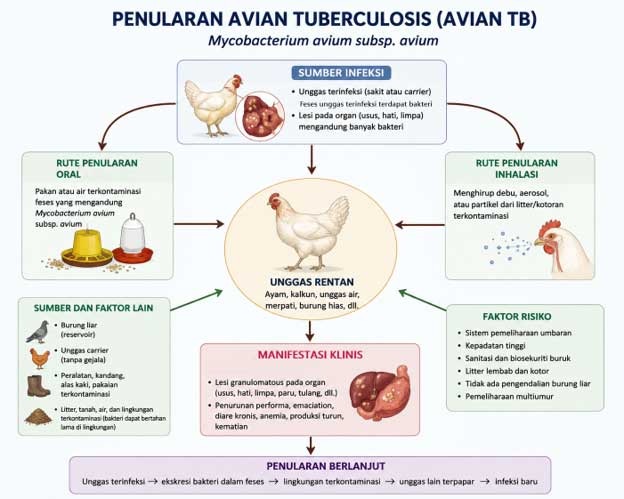 This disease is primarily caused by Mycobacterium avium subsp. avium, a bacterium capable of infecting almost all bird species, ranging from chickens, turkeys, and waterfowl to pigeons, ornamental birds, and wildlife. One of the reasons why mycobacteriosis is incredibly difficult to control is the causative bacteria’s ability to persist in the environment for extended periods.
 REFERENCES