Bagaimana cara mendapatkan dan berlangganan majalah Poultry Indonesia?
Bagaimana cara membayar pesanan majalah Poultry Indonesia?
Apa itu Advertorial?
Bagaimana cara memasang iklan di website Poultry Indonesia?
Dari mana referensi informasi dalam majalah poultry indonesia?
Dengan siapa saya bisa bertanya seputar kesehatan, penyakit terkait unggas?
Apa itu Poultry Events?
Dengan siapa saya bisa ingin mengajukan kerjasama media partner atau mengadakan suatu kegiatan?
Apa itu Poultry Indonesia?
Poultry Indonesia merupakan majalah yang didirikan pada tahun 1979 di Jakarta, dan menjadi majalah pertama dan tertua di Indonesia yang memiliki ulasan khusus mengenai perunggasan.
Referensi informasi yang tersaji dalam majalah Poultry Indonesia tidak hanya tercakup dalam negeri saja, Poultry Indonesia telah menjalin kerjasama dengan berbagai pihak luar negeri untuk menyajikan informasi terkait perkembangan perunggasan di luar Indonesia.
Poultry Indonesia terdiri dari sekelompok orang yang memiliki dedikasi dan apresiasi tinggi terhadap pekerjaan mereka, dengan senantiasa selalu menyajikan sebuah majalah yang layak dibaca oleh masyarakat perunggasan.
Kapan Majalah Poultry terbit?
Majalah Poultry Indonesia terbit per bulan pada minggu ke-2 dan memiliki dua belas edisi setiap tahun.
Bagaimana cara mendapatkan dan berlangganan majalah Poultry Indonesia?
Majalah Poultry Indonesia tersedia di Toko Buku Gramedia namun dengan kuantiti terbatas. Anda bisa juga langsung membeli dengan menghubungi Poultry Indonesia melalui:
Advertorial adalah artikel yang dimuat di media massa dengan cara membayar yang bertujuan untuk promosi.
Selain itu juga advertorial bisa diartikan sebagai iklan yang disusun atau dibuat sedemikian rupa
sehingga seperti sebuah artikel yang dikarang oleh media cetak yang bersangkutan.
Bagaimana cara memasang iklan di website Poultry Indonesia?
Untuk dapat memasang iklan pada Website Poultry Indonesia dapat menghubungi Divisi Iklan melalui Email:
Darimana referensi informasi dalam majalah poultry indonesia?
Referensi informasi yang tersaji dalam majalah Poultry Indonesia tidak hanya tercakup dalam negeri saja, Poultry Indonesia telah menjalin
kerjasama dengan berbagai pihak luar negeri untuk menyajikan informasi terkait perkembangan perunggasan di luar Indonesia.
Koresponden Luar Negri:
Elis Helinna (New York, Amerika Serikat)
Koresponden Dalam Negeri:
Boy Gunawan Agustino (Tegal),
Muhrishol Yafi (Sidoarjo),
Mahardika Agil Bimasono (Yogyakarta), Sri Maulidini (Purwokerto),
Tri Okto Sareji Adytia (Poso).
Dengan siapa saya bisa bertanya seputar kesehatan, penyakit terkait unggas?
POULTRYINDONESIA, Bogor – Responding to the recent press conference held by the Ministry of Agriculture together with representatives of layer farmers, the Indonesian Independent Smallholder Farmers Association (PERMINDO) expressed its appreciation for the government’s attention to the challenges currently faced by smallholder farmers due to market imbalances.
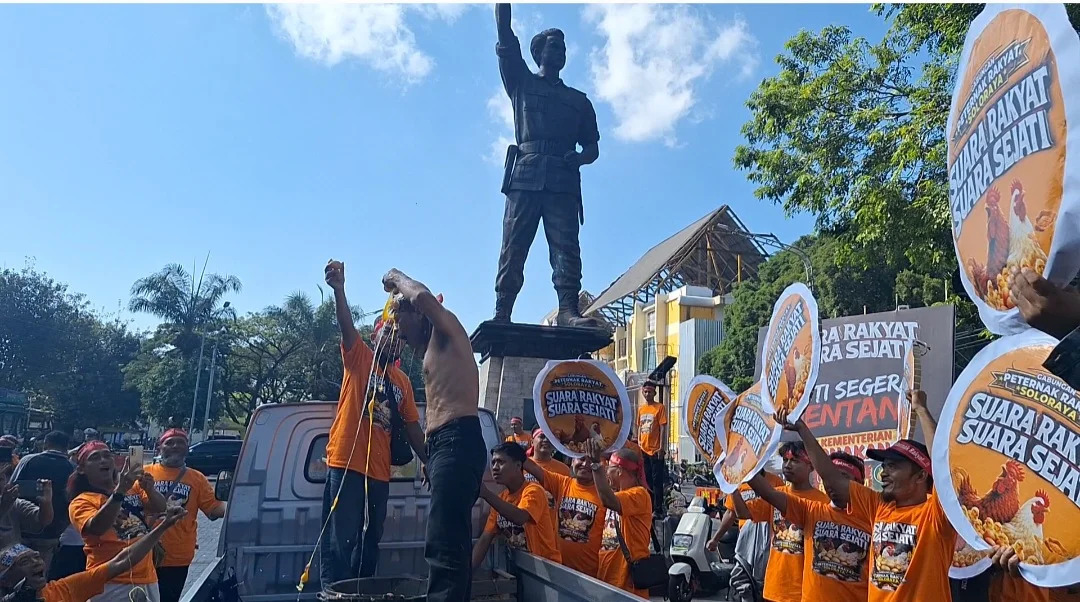
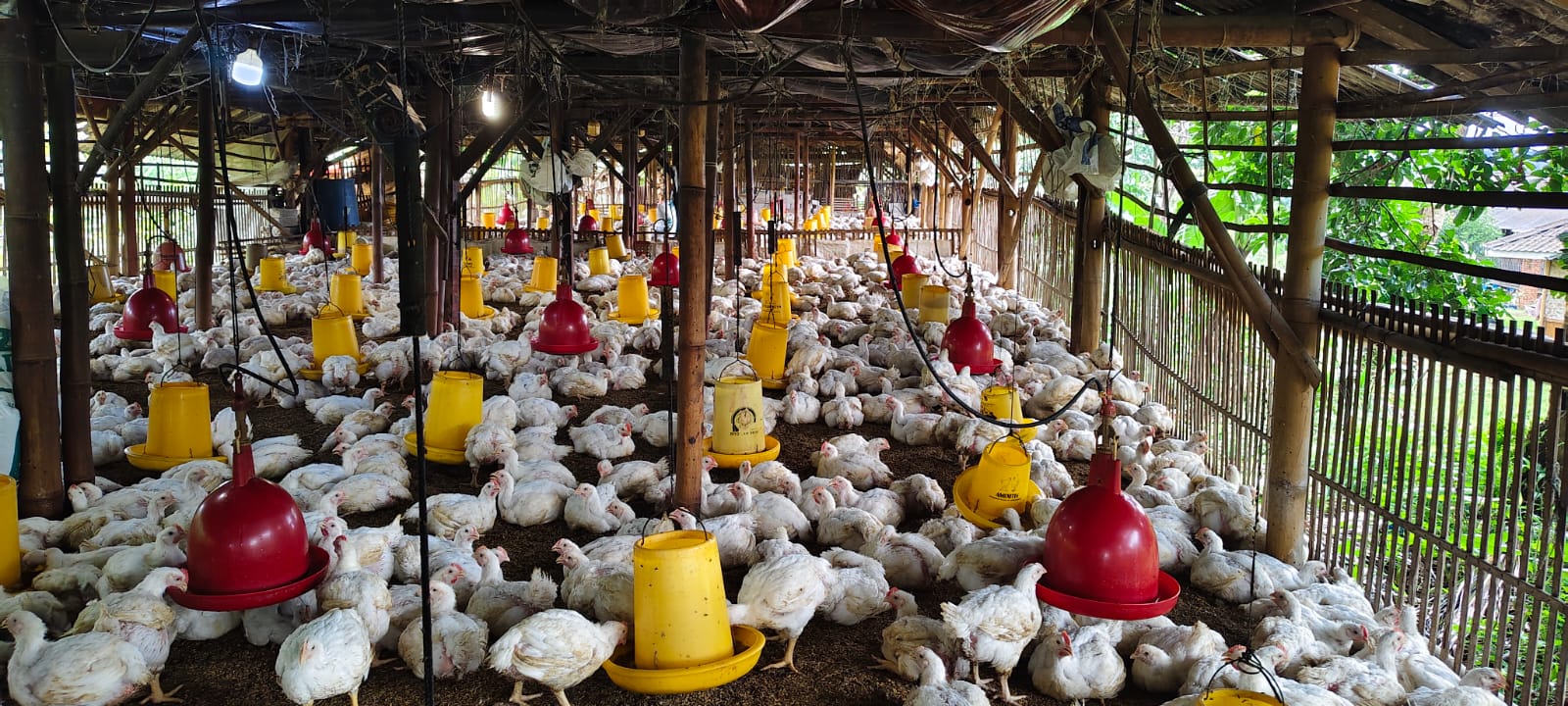
However, PERMINDO Chairman Kusnan emphasized that the problems faced by poultry farmers are not limited to the layer sector. Broiler farmers are also experiencing severe pressure as live bird (LB) prices remain far below production costs.
“PERMINDO hopes that the Ministry of Agriculture will also provide an equal platform for representatives of independent broiler farmers to engage in dialogue, so that the actual conditions in the field can be conveyed directly to the Minister of Agriculture and become part of the formulation of national solutions for the poultry sector,” he said in a written statement on Wednesday (June 10, 2026).
According to Kusnan, broiler farming operations are currently under tremendous pressure. Throughout 2026, feed prices have increased cumulatively by around IDR 800 per kilogram, with current prices ranging between IDR 8,800 and IDR 9,400 per kilogram (ex-factory). Meanwhile, the price of final stock DOC (day-old chicks) for chickens currently being harvested remains at approximately IDR 5,000–6,000 per chick.
As a result of rising production costs, the cost of production (HPP) for broilers is estimated to have reached IDR 21,000–22,000 per kilogram of live bird. In contrast, live bird prices in the Greater Jakarta (Jabodetabek) and Banten regions remain at only IDR 15,000–16,000 per kilogram.
“This situation causes farmers to suffer losses of around IDR 5,000–7,000 per kilogram of live bird, or the equivalent of IDR 10,000–14,000 per two-kilogram chicken. This condition cannot continue for long because it threatens working capital and may force smallholder farmers to cease operations,” Kusnan stressed.
Meanwhile, PERMINDO Secretary General Heri Irawan stated that the core issue facing farmers today is not production itself, but rather the limited market capacity to absorb the abundant supply of chicken meat and eggs produced nationally.
“Therefore, in addition to the Ministry of Agriculture, we hope for active involvement from the Coordinating Ministry for Food Affairs, the Ministry of Trade, the National Food Agency (Bapanas), Bulog, and state-owned food enterprises in building a stronger absorption and distribution system,” he said.
In a written statement received by Poultry Indonesia, PERMINDO proposed several strategic measures to strengthen Indonesia’s poultry market, including:
Expanding access to poultry products in modern retail channels nationwide, including fresh chicken carcasses, frozen chicken, and eggs, to increase consumption while creating broader market opportunities for smallholder farmers.
Establishing sustainable procurement programs through Bulog and state-owned food enterprises as market stabilization instruments during periods of oversupply and declining farm-gate prices.
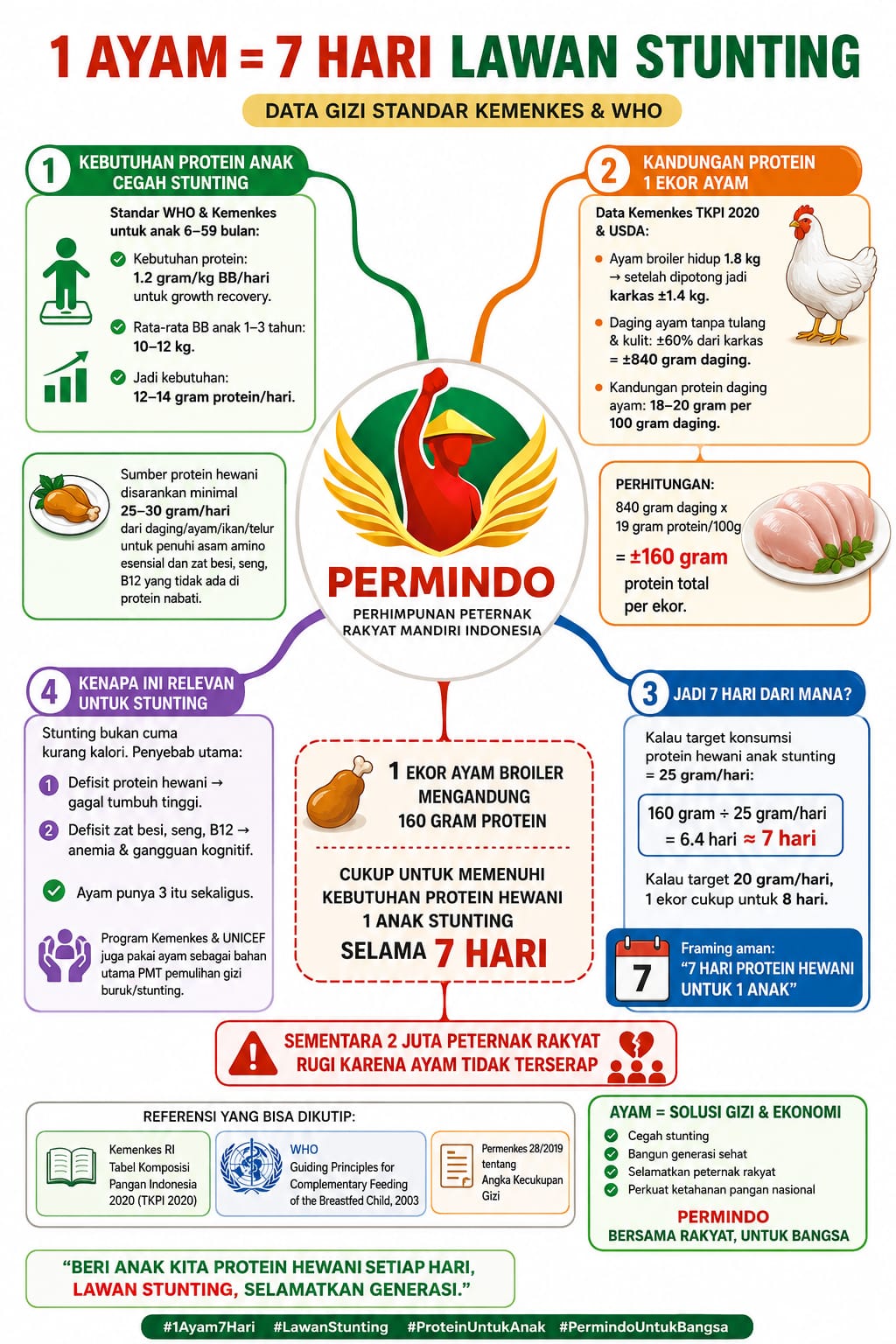
Integrating poultry products into various government programs, including the Free Nutritious Meals Program (MBG), stunting prevention initiatives, food assistance programs, government food reserves, and institutional demand from Islamic boarding schools, schools, hospitals, the Indonesian National Armed Forces (TNI), and the National Police (Polri).
Strengthening interregional and inter-island distribution through national logistics support, cold chain development, expansion of regional cold storage facilities, and stronger distribution networks.
Developing a more accurate national poultry production and demand map to guide future livestock investment. Currently, approximately 70% of Indonesia’s broiler and layer populations remain concentrated on Java Island, often leading to oversupply.
Establishing a National Animal Protein Reserve based on chicken meat and eggs as an instrument for supply and price stabilization while supporting national food security.
Launching a national “People’s Chicken Against Stunting” program by distributing chicken products to families at risk of stunting, pregnant women, and nutritionally vulnerable groups. The program is considered capable of aligning the interests of smallholder farmers with national nutrition improvement goals.
Heri expressed confidence that if the government succeeds in building a stronger market, distribution, and procurement system, healthier chicken and egg prices can be achieved without relying solely on production-cut policies.
“Future national poultry policies cannot focus only on production. More importantly, they must create new markets, expand consumption, strengthen distribution, and ensure that the output of smallholder farmers is properly absorbed,” Heri emphasized.
He further stressed that smallholder farmers are not seeking subsidies or direct government assistance. Instead, what farmers need is broader market access, improved distribution systems, and guarantees that their products can be absorbed fairly by the market.
“The poultry sector’s problem today is not a lack of production, but rather an underdeveloped market and distribution system. When production costs have reached IDR 21,000–22,000 per kilogram while live bird prices are only IDR 15,000–16,000 per kilogram, farmers are not selling for profit—they are selling at a loss,” he concluded.







 Meanwhile, PERMINDO Secretary General Heri Irawan stated that the core issue facing farmers today is not production itself, but rather the limited market capacity to absorb the abundant supply of chicken meat and eggs produced nationally.